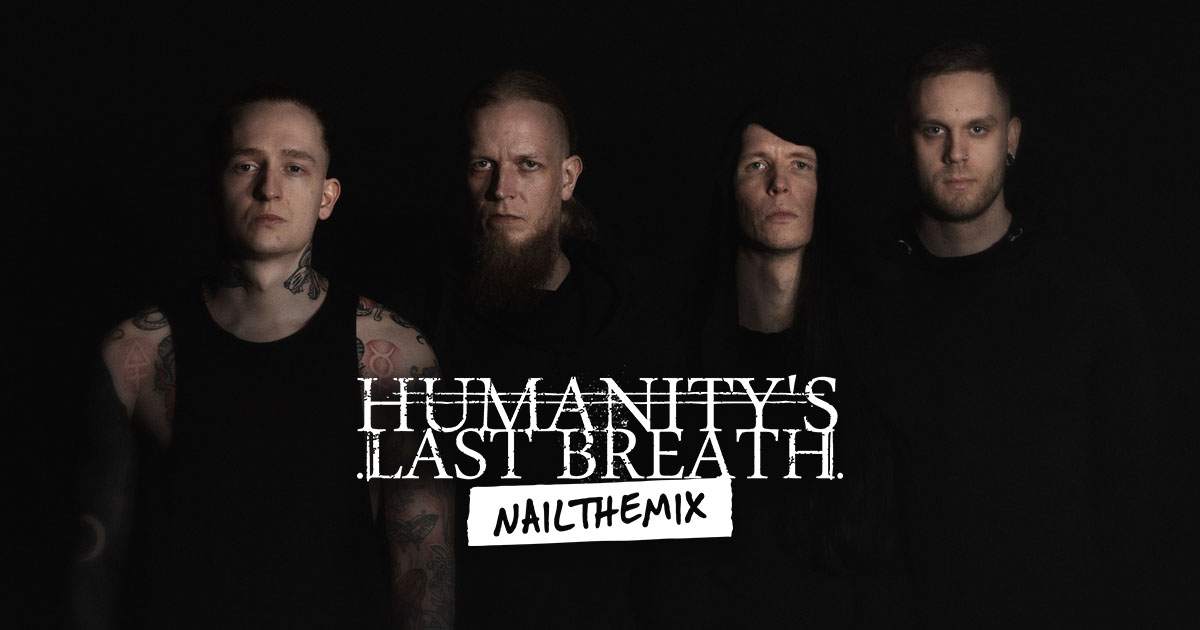
Dialing Humanity’s Last Breath’s Crushing Guitar Tones with Buster Odeholm
Nail The Mix Staff
The guitar tone of Humanity’s Last Breath is an undeniable force of nature. It’s heavy, it’s brutally low, and it’s meticulously crafted by producer and multi-instrumentalist Buster Odeholm. If you’ve ever wondered how he conjures that sound that feels like the sonic equivalent of a collapsing star, you’re in the right place.
We’re diving into the techniques Buster Odeholm himself revealed, breaking down his DI processing, amp sim choices, and even his mind-bendingly clean pitch-shifting method for getting guitars into the abyss.
The Foundation: DI Prep and Amp Sim Choice
Before you even think about an amp, it starts with the DI. Buster’s DI tone is already incredibly tight and loaded with low-end and high-mids, giving it a “djenty” character from the get-go. But even a great DI needs shaping before it hits the distortion stage.
Taming the DI Before the Amp
First things first, Buster attacks the scratchy, fizzy top-end of the raw DI signal. While some producers make this work, he prefers to remove it for his particular style. Using an EQ, he’ll surgically cut out that unwanted harshness, cleaning up the signal before it ever sees gain.
Next is a slick trick to enhance aggression: boosting attack in the high-mids. This technique, almost like transient shaping for your DI, adds a percussive and aggressive edge. By cranking this, the guitar hits harder without needing to pile on excessive pre-amp EQ, giving the notes more definition and bite.
The Amp: Pod Farm’s Big Bottom
For the core of his tone, Buster turns to a certified classic: Line 6’s Pod Farm. Specifically, he uses the Big Bottom amp model. This isn’t just a random choice; it’s a legendary tone. It’s the amp behind the early sounds of Tesseract and Monuments, and famously, the tone on Meshuggah’s Catch 33.
Why this amp? The Big Bottom model is renowned for its ability to handle extremely low frequencies without falling apart or becoming thin. It retains its weight and power, which is absolutely essential for the sub-zero tunings of Humanity’s Last Breath. It might sound a bit older and harsher than modern sims like Neural DSP out of the box, but with some patience and smart EQ, it delivers the goods.
It’s also worth noting that while he uses the Pod Farm amp, he bypasses the stock cabinets in favor of GGD Cabs.
The Boost Pedal Philosophy
Inside Pod Farm, Buster uses a boost pedal, but not in the way you might think. Many producers use a drive pedal to cut low-end and tighten the signal. Buster goes a different route. His boost is primarily an EQ boost.
He cranks the high-mids and adds about 50% on the treble. Crucially, this boost doesn’t cut the lows. This allows the full frequency spectrum of the low-tuned guitar to hit the amp, preserving the immense weight and body of the tone. The Big Bottom amp is one of the few models that can take this full-range signal and turn it into usable, heavy distortion.
Shaping the Tone: Bus Processing and EQ
With the core tone dialed in, the next stage is shaping it to sit perfectly in a dense mix. This involves a series of detailed EQ moves and compression on the main guitar bus.
Carving with Surgical and Broad EQ
Buster employs a multi-layered EQ strategy. First, he uses smaller, more surgical EQ cuts to tame problem areas and enhance clarity, such as dipping some mud around 200Hz and removing a bit of harshness around 3kHz.
But here’s a massive takeaway for modern mixing: the “Bluetooth speaker” trick. To ensure his guitars translate and remain audible on smaller consumer systems like car stereos and portable speakers, he adds a 4dB boost to the mids, but only in the M/S processor’s mid-channel. This pushes the core of the guitar tone forward, making it far more present on systems that can’t reproduce the scooped, wide-panned sound common in metal.
Glue and Control with Compression
To make the guitars feel like a single, cohesive unit, Buster uses multiple stages of compression. One compressor is set with a fast release to help glue the tracks together. Another is used to specifically control the build-up of low-mid energy around 150Hz.
He also uses a tried-and-true compressor with a slow attack and fast release—a classic setting he credits to a Brian Hood class—which helps add punch and consistency without squashing the life out of the performance.
Making Space with Sidechain
Finally, to ensure the kick drum has its own space to punch through the wall of guitars, he applies a simple sidechain compressor to the guitar bus. When the kick hits, the guitars duck in volume just a tiny bit, creating space and enhancing the rhythmic impact of the song.
The Secret to Artifact-Free Pitch Shifting
So, how do you pitch a guitar down to unholy depths without it turning into a glitchy, digital mess? While Buster often prefers the “dirtier” sound of a real-time pitch pedal like a DigiTech Whammy, he revealed a method for achieving perfectly clean, artifact-free pitch shifting. It’s work, but the results are flawless.
The core principle is this: artifacts are created when a processor is forced to pitch audio down while maintaining its original length. To avoid this, you have to let the audio slow down as it’s pitched down.
The Process: Time-Stretching for Clarity
- Chop It Up: First, you have to cut up the guitar recording into individual notes or chords. Every single chug becomes its own separate audio clip.
- Offline Pitching: Using your DAW’s offline pitch-shifting algorithm (not a real-time plugin), select the clips you want to process.
- Pitch and Stretch: As you pitch the audio down (for example, 7 semitones), you must disable any time-correction. This means the pitched-down audio clip will become physically longer. Because you’re not fighting the algorithm to maintain the original timing, no nasty artifacts are generated.
- Maintain the Grid: Since you already cut each note into an individual clip, they will all remain in their correct “start” positions on the timeline. Even though each note is now slightly longer, the performance’s timing is perfectly preserved.
It’s a meticulous, editing-intensive process, but if you need to pitch something down with absolute clarity, this is the way to do it.
Humanity's Last Breath on Nail The Mix
Buster Odeholm mixes "Labyrinthian"
Get the Session
Take Your Mixes to the Next Level
From DI prep and amp selection to surgical bus processing and clever production tricks, crafting a tone like this is a game of details. Applying these concepts—like using EQ boosts instead of drive pedals or boosting the mid-channel for translation—can instantly elevate your heavy guitar tones.
Techniques like these are just the tip of the iceberg. Imagine watching the world’s best producers apply these principles in real-time on real sessions from bands like Thrown, Periphery, and Spiritbox. At Nail The Mix, you get exactly that. Every month, you gain access to the raw multitracks from a major metal release and watch the original producer mix it from scratch, explaining every single decision along the way. It’s time to unlock your sound and start mixing modern metal beyond presets.
And for those who want to dive really deep, get Buster’s course “How It’s Done.”