
Guitar EQ FAQs: Pro Answers for Modern Metal Producers
Nail The Mix Staff
Getting heavy guitar tones to sit right in a dense metal mix is one of the biggest hurdles producers face. It’s a constant battle against mud, fizz, and finding that perfect pocket where everything slams without turning into a wall of noise. You’ve probably spent hours tweaking knobs, moving mics, and swapping amp sims, only to end up frustrated.
The truth is, a killer modern metal guitar sound isn’t just about scooping the mids and calling it a day. That’s a relic of the past. The modern approach is about precision, enhancing performance, and understanding that your EQ choices are only as good as the playing they’re meant to serve. The best players have an insane level of rhythmic command and technical skill, and a great mix engineer’s job is to use tools like EQ to make sure every bit of that nuance and aggression translates.
Let’s break down some of the most common guitar EQ questions, giving you actionable answers you can apply to your next mix.
Foundational Guitar EQ Questions
What are the “must-have” guitar EQ plugins?
While your stock DAW EQ can get the job done, having a couple of specialized tools can seriously speed up your workflow and deliver better results. Think of your EQs in two main categories:
1. Surgical EQs (The Scalpels)
These are for cleaning up problems with pinpoint accuracy. They’re transparent and let you make narrow cuts to remove nasty frequencies without wrecking the overall tone.
- FabFilter Pro-Q 3: This is the undisputed king for a reason. Its visualizer is incredible for hunting down problem frequencies, and its dynamic EQ feature is a game-changer. You can set a band to only cut a frequency when it gets too loud—perfect for taming palm-mute “flub” without thinning out the whole track.
- Your Stock EQ (Seriously): Don’t sleep on what comes with Logic, Pro Tools, Reaper, or Cubase. They’re clean, low on CPU, and perfect for basic high-pass filtering and surgical notches.
2. Character EQs (The Paintbrushes)
These EQs are designed to add pleasing color, warmth, or vibe. They’re often emulations of classic analog hardware and are great for broad, musical boosts.
- Pultec EQP-1A Emulations (Waves, UAD, Tube-Tech): Famous for its “low-end trick” where you can boost and cut the same low frequency, creating a tight, powerful bottom end. It’s also incredible for adding smooth, non-harsh “air” to the top end.
- SSL E-Channel/G-Channel Emulations (Waves, Plugin Alliance, Brainworx): The go-to channel strip for countless metal records. The EQ is punchy and aggressive, and the built-in filters and dynamics are perfect for shaping tones quickly and effectively.
What frequencies should I be cutting on metal guitars?
Before you even touch an EQ, listen. What’s the problem? Don’t just cut frequencies because a chart told you to. That said, there are common problem areas that consistently pop up with high-gain guitars.
- Low-End Rumble (Below 80-120Hz): This is just useless mud that clashes with the kick and bass. Use a steep high-pass filter (HPF) and move it up until the guitars start to sound thin, then back it off just a bit. For down-tuned 7 or 8-string guitars, be more gentle, but you’ll almost always need a filter here.
- Boxiness/Mud (~250-500Hz): A buildup in this range can make your guitars sound muffled and clunky, like they’re being played inside a cardboard box. A broad cut here can instantly clean things up and create space for the snare’s fundamental punch.
- Nasal “Whistle” or “Honk” (~800Hz – 2kHz): Sometimes a specific annoying frequency will poke out, especially with certain amp and cab combinations. Use a surgical EQ with a narrow Q to find that “honky” tone and notch it out. Be careful not to cut too broadly, or you’ll lose all the bite and aggression.
- High-End Fizz (~5kHz – 10kHz): This is that cheap, static-y, “bees in a can” sound. Instead of a broad low-pass filter (which can make guitars sound dull), try a high-shelf cut to gently roll off the harshness, or use a surgical EQ to find the most offensive fizzy peaks and pull them down.
For more on managing low-end, check out our guide to EQing metal guitars for max impact.
Advanced EQ Techniques For Heavy Tones
High-pass filter vs. low-shelf: what’s better for cleaning up the low end?
They both have their place. A high-pass filter (HPF) completely removes all frequencies below a certain point. A low-shelf just turns down the volume of frequencies below a certain point.
Here’s a practical workflow:
- On Individual Tracks: Use a steep HPF on each individual rhythm guitar track. This is for surgically removing the sub-bass mud and creating a clean foundation.
- On the Guitar Bus: Send all your rhythm guitars to a bus or group track. Here, you can use a gentle low-shelf cut if the combined guitars still feel a bit too boomy or thick in the low-mids. This retains some of the weight while still controlling the mud, helping to glue the tracks together.
How do I make my guitars sound huge without being muddy?
This is the million-dollar question. It’s less about a single EQ trick and more about a combination of great performance, thoughtful arrangement, and smart processing.
- It Starts With The Performance: Two guitars playing a riff in perfect sync will sound infinitely bigger and heavier than four sloppy takes. Modern metal is defined by rhythmic precision. If the playing is tight, you won’t have to do as much corrective EQ to fix phase issues and timing slop.
- Focus on the Mids: Huge guitars don’t come from massive low end. They come from a powerful, clear, and aggressive mid-range. Instead of just scooping, think about what you can boost. Find the frequency that gives you the “growl” (often around 800Hz) or the “pick attack” (around 2-4kHz) and give it a slight, broad boost.
- Create Stereo Separation: Don’t EQ your hard-panned left and right guitars identically. Try making one slightly brighter and the other with a bit more body in the low-mids (~500-700Hz). This subtle difference will make the stereo field feel wider and more defined.
EQ in a Modern Metal Context
Everyone says “tone is in the hands,” so how much does EQ really matter?
They’re 100% right. Tone is in the hands. Or more accurately, it’s in the picking hand. Your ability to downpick consistently, mute strings effectively, and play complex rhythms with machine-like precision is the foundation of modern metal tone. No amount of EQ can fix a sloppy riff.
Think of it this way: a great performance is the signal. EQ is the tool that ensures that signal is delivered clearly in the mix.
EQ matters because it lets you:
- Carve Space: You cut the mud from the guitars so the bass can own the low end. You dip the mids in the guitars so the snare can crack through.
- Enhance Aggression: You boost the upper-mids to bring out the pick attack and make the riff feel more urgent and in-your-face.
- Remove Distractions: You notch out fizzy frequencies and annoying whistles so the listener can focus on the power of the riff itself.
Your EQ should serve the performance, not create it. To go deeper on this, dive into our resources on metal compression secrets, as dynamics and EQ go hand-in-hand.
Should my amp sim EQ be flat before I use plugins?
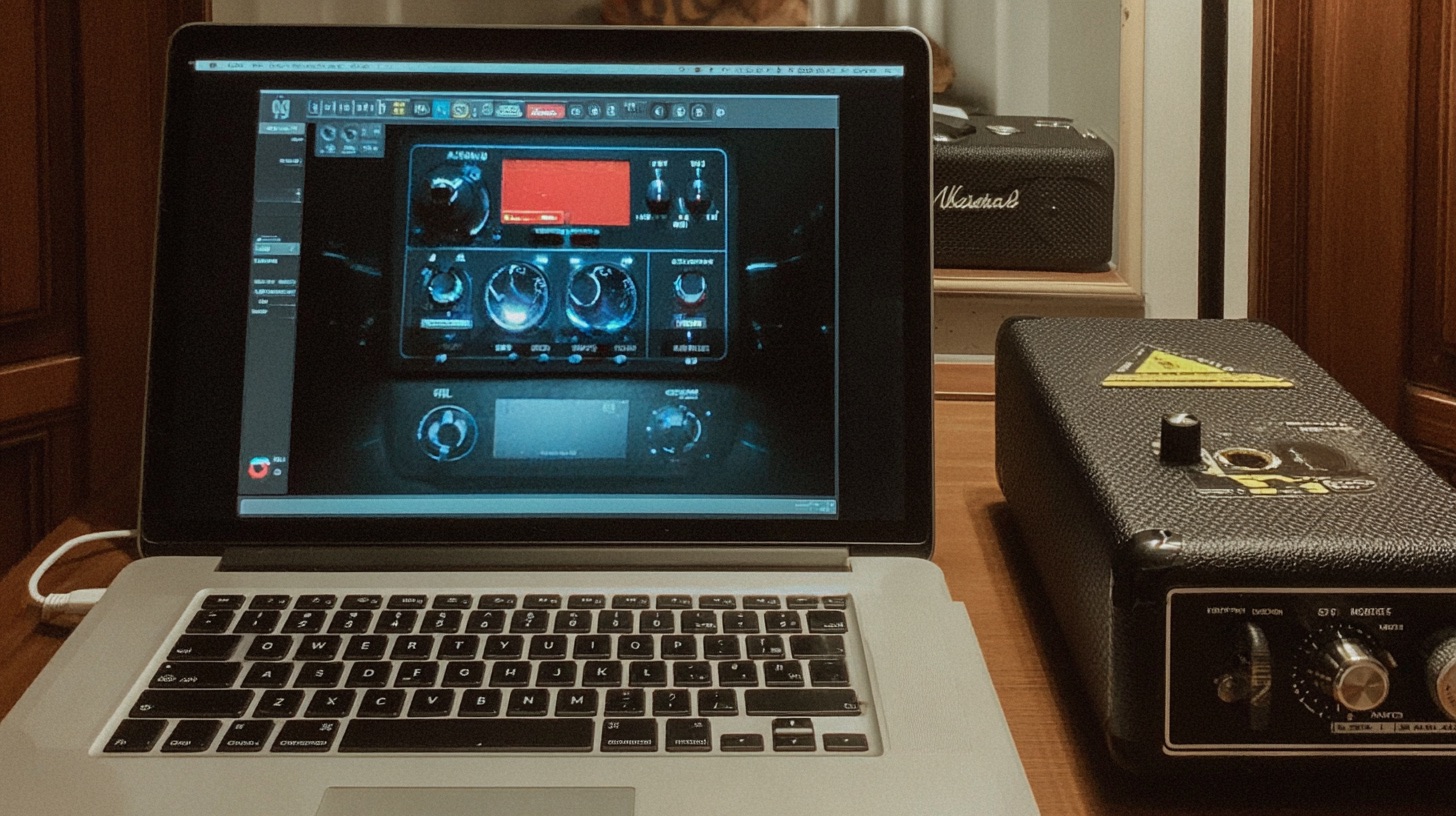
Not at all. Think of the EQ controls on your amp sim (like a Neural DSP Archetype, Positive Grid BIAS, or Helix Native) just like you would on a real amp. Use the Bass, Mid, and Treble knobs to shape the core character of your sound. Get it 80-90% of the way there at the source.
Your plugin EQs should be used for the “mixing” moves—the surgical cuts and broad sweetening that help the guitar sit in the context of the full track.
- Amp Sim EQ: For shaping the fundamental tone.
- Plugin EQ: For fitting that tone into the mix.
See How The Pros Do It
Reading about EQ curves is one thing. Watching a world-class producer dial them in on a real session is a completely different experience.
That’s what Nail The Mix is all about. You get to watch legendary instructors like Jens Bogren, Adam “Nolly” Getgood, and Will Putney mix iconic songs from bands like Meshuggah, Periphery, and Fit For An Autopsy, explaining every EQ, compression, and automation move they make. You get the raw multitracks to mix alongside them and see exactly how they tackle these same challenges.
If you’re ready to stop guessing and start learning the techniques that actually work, check out our full catalog of Nail The Mix sessions and see what it’s all about.