
Phase FAQs: Your Guide to a Tighter, Punchier Metal Mix
Nail The Mix Staff
You’ve tracked killer performances. You’ve dialed in massive tones with your favorite Neural DSP Archetype or a real cranked 5150. You start putting the pieces together, but something’s… off. The kick drum feels weak, the guitars sound thin and hollow, and the low-end is a muddy mess. What gives?
Chances are, you’re dealing with phase issues.
Phase is the invisible force that can either supercharge your mix or suck the life right out of it. For modern metal producers aiming for that polished, punchy, and incredibly tight sound, understanding and managing phase isn’t just a good idea—it’s a non-negotiable part of the job.
Let’s break down the most common questions about phase and give you actionable answers to fix it.
What is phase, and why should I care?
Forget the boring physics textbook definition. For a metal producer, here’s what phase means: When you record a single source with more than one microphone (or blend a DI with a mic’d signal), you’re capturing slightly different versions of the same sound wave arriving at slightly different times.
- When they’re “in phase,” the peaks and troughs of the sound waves line up, reinforcing each other. This results in a fuller, louder, more powerful sound. Think of a perfectly tight kick drum that hits you in the chest.
- When they’re “out of phase,” the peak of one wave lines up with the trough of another. They cancel each other out, often in specific frequency ranges. This results in a thin, hollow, or filtered sound. Think of a snare drum that loses all its body or guitars that just sound wimpy.
In a dense metal mix where every element is fighting for space, phase cancellation can turn your massive rhythm guitars into a fizzy mess and your cannon-shot snare into a wet paper bag. That’s why you should care.
How do I check for phase issues?
Before you can fix the problem, you need to find it. Luckily, your ears and your DAW give you a few simple tools to become a phase detective.
The Mono Button Method
This is your #1 weapon. Sum your mix to mono periodically. Since mono combines the left and right channels, any phase cancellation between stereo elements becomes immediately obvious. If your wide-panned heavy guitars suddenly lose all their low-end or your overheads make the snare disappear when you hit the mono button, you’ve got a phase problem.
The Polarity Invert Switch (ø)
This little button, often labeled with a “ø” symbol, is on virtually every channel strip in every DAW. It flips the polarity of the audio signal by 180 degrees. If you have two mics on one source (like a snare top and bottom), solo them, and flip the polarity on one of them. Whichever setting sounds fuller and has more low-end is the correct one.
Look at the Waveforms
This is the visual check. Zoom in on your tracks so you can see the individual waveforms. If you’re blending a bass DI and a mic’d amp, for example, line them up and look at the initial transient of a note. Are both waveforms moving in the same direction first (e.g., both going up)? If one goes up while the other goes down, they’re out of polarity.
Where do phase issues happen most in a metal mix?
Phase problems can pop up anywhere you use multiple mics or signals, but in metal production, there are three main culprits.
Drums: The Main Offender
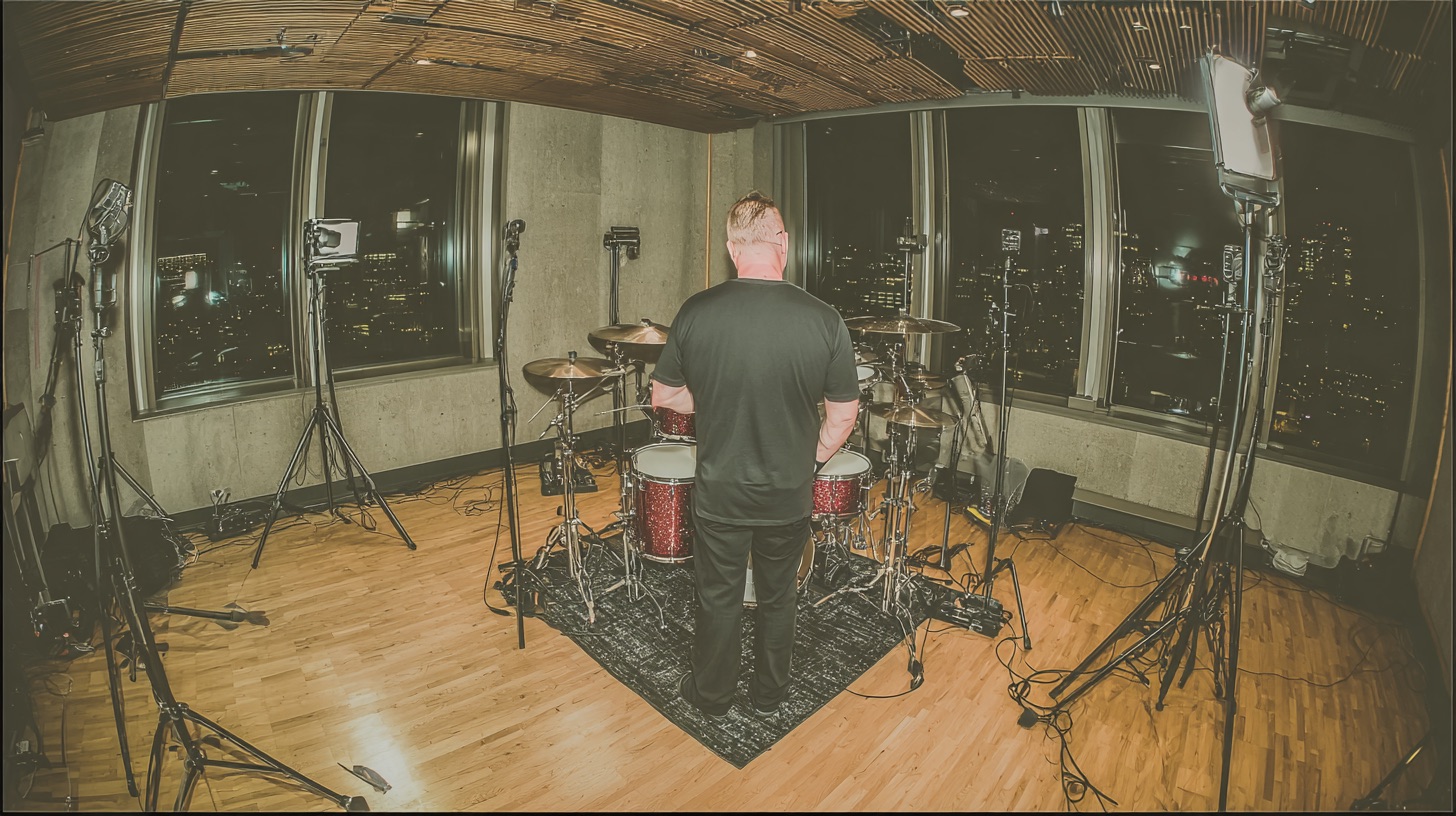
Multi-mic’d drums are a phase minefield. Getting them right is one of the biggest parts of mixing drums effectively.
- Snare Top & Bottom: The bottom mic will almost always be out of polarity with the top mic because it’s pointing in the opposite direction. Your first move should always be to flip the polarity on the snare bottom channel. You should hear the low-end and body of the snare immediately snap into focus, creating a solid foundation for adding snare compression later.
- Kick In & Out: The mic inside the kick (like a Shure Beta 91A) captures the sharp attack, while the mic outside (like a Solomon LoFReQ or AKG D112) captures the subby low-end. The sound takes a few milliseconds longer to reach the outside mic. Zoom in on the waveforms and nudge the kick-in track slightly forward to align its transient with the kick-out track. You’ll be shocked at how much sub-bass you gain; a critical step for a modern metal kick drum.
- Overheads & Close Mics: The overheads can have phase conflicts with every single close mic on the kit. Check them against the snare, toms, and kick one by one using the polarity switch and the mono button.
Guitars: The Low-End Killer
Modern metal is built on tight, quad-tracked rhythm guitars and blended DI/amp tones.
- Blending DI and Amp/Sim: When you re-amp a DI, or blend a DI signal with a plugin like the Archetype: Gojira X, there will be a tiny time difference between the two signals due to latency and processing. This can hollow out the low-mids and make your chugs sound weak. Manually nudge the DI to align it perfectly with the amp track.
- The Fredman Technique: This classic metal micing technique uses two Shure SM57s on a single speaker—one on-axis, one angled. This intentionally creates a specific phase interaction that adds aggression and bite. It’s an example of using phase creatively. However, it’s still crucial to check how these mics interact and find the blend that works. If not done right, it can still result in a thin tone. Perfecting this is key, and it’s a big part of creating guitars that don’t need a ton of surgical EQ work later on. For more on shaping these tones, check out our guide to mixing low-tuned guitars.
Bass: The Foundation of the Mix
A modern metal bass tone is often a blend of a clean DI signal for the fundamental low-end and a separate, heavily distorted track for grit and midrange. Just like with guitars, these two signals must be perfectly phase-aligned. If they’re not, the distorted track can cancel out the very low-end you’re trying to preserve with the DI, leaving you with a clanky, thin bass that has no weight.
What are the best tools for fixing phase?
You’ve identified a problem. Now how do you fix it?
H3: The Polarity Switch (Again)
We can’t stress this enough. For simple polarity issues like a snare bottom mic, this is your first and final stop. It’s instant, easy, and built into your DAW.
H3: Nudging Tracks
For timing-based phase issues, manually sliding a track a few samples or milliseconds forward or backward in your DAW is the old-school, tried-and-true method. It’s free and forces you to use your ears. Zoom in, align the first big peak of the waveform, then zoom out and listen. Adjust to taste.
H3: Dedicated Phase Alignment Plugins
When you need more precision or are short on time, dedicated plugins are lifesavers.
- SoundRadix Auto-Align 2: This is the industry standard for a reason. You put it on your source track (e.g., snare top) and your other tracks (snare bottom, overheads), and it automatically calculates and applies the precise time and polarity correction needed for maximum coherence. It’s an absolute game-changer for drums.
- Waves InPhase: This plugin gives you a manual control, allowing you to see the phase relationship visually and adjust the delay and phase rotation yourself. It’s great for fine-tuning bass and guitar tracks.
- Little Labs IBP (by UAD): The IBP (In-Between Phase) plugin allows you to continuously rotate the phase of a signal, letting you dial in the sweet spot between fully in-phase and fully out-of-phase.
Getting your tracks phase-coherent is a huge step toward making your mix punchier. A well-aligned mix also responds much better to bus processing like compression, helping you achieve that glued-together, pro-level sound.
Is phase cancellation ever a good thing?
Mostly, you’ll be fighting against phase cancellation. But sometimes, it can be a creative tool. As mentioned, the Fredman micing technique harnesses phase to create a specific guitar tone. Effects like phasers and flangers are literally built on phase manipulation.
However, for the core drum, bass, and rhythm guitar tracks that form the foundation of a modern metal mix, phase coherence is king. You want maximum impact, maximum punch, and maximum clarity. That means getting those waveforms working together, not against each other.
See How The Pros Do It
Reading about phase alignment is one thing. Watching a world-class producer hunt down and fix these issues in a real-world session is another. On Nail The Mix, you can watch legendary instructors like Will Putney, Joey Sturgis, and Dan Braunstein tackle these exact problems.
Our catalog of sessions gives you access to the raw multitracks from bands like Spiritbox, Gojira, and Lamb of God, allowing you to see and hear exactly how a few milliseconds of delay or a simple polarity flip can be the difference between an amateur mix and a radio-ready banger.