
Modern Metal Guitar Recording FAQs
Nail The Mix Staff
You’re chasing that devastatingly tight, clear, and aggressive modern metal guitar tone. But the internet is a minefield of conflicting advice. Some say it's all about seven-strings and amp sims, while others romanticize old-school tube amps and analog gear, claiming everything new sounds "sterile." What actually works?
Let’s cut through the noise. Here are the answers to the most common guitar recording questions for modern metal, based on what the top producers are actually doing right now.
Is modern metal guitar tone just about low tunings and amp sims?
Not even close. That’s like saying ‘80s guitar was just about whammy bars. Yes, extended-range guitars, drop tunings, and plugins like the Archetype series from Neural DSP are everywhere. But those are just tools. Focusing on them is a surface-level take that misses the entire point.
The real shift isn't the gear; it's the player. The average high school shredder today has a technical and rhythmic vocabulary that would have been considered pro-level 20 years ago. Why? The internet.
They have instant access to 4K playthroughs of their heroes, online lessons from world-class players, and DAWs to record and analyze their own playing with surgical precision.
Modern tools don't just "fake" a good performance; they enable a higher level of musicianship. A guitarist can now use an affordable tool like the Positive Grid Spark NEO headphone amp to practice silently on the tour bus with a metronome, backing tracks, and their exact tone, something that was impossible before. So no, it’s not about the low tunings—it’s about the relentless precision that has become the new standard.
What really defines a "modern" metal guitar sound?
Modern metal is defined by a combination of insane precision, expanded technical vocabulary, and intelligent gear choices that serve the song. It’s less of a specific sound and more of a philosophy built on pushing the envelope.
It starts with rhythmic precision
The single most important element is the picking hand. The rhythmic complexity in metal has evolved dramatically. It’s about more than just speed; it’s about endurance for consistent down-picking, perfect alternate picking across strings, and the ability to lock into complex polyrhythms and odd time signatures without flinching. The old-school separation of "rhythm guitarist" and "lead guitarist" is dead. Today’s best players are masters of both.
Expanded technical vocabulary
The lines between genres are blurring. Top-tier metal guitarists are incorporating techniques that used to be confined to fusion or prog. You’ll hear:
- Hybrid Picking: Using both the pick and fingers for complex arpeggios and string skipping.
- Thumping: A percussive technique popularized by players like Tosin Abasi.
- Advanced Tapping: Rhythmic, multi-finger tapping patterns inspired by players like Tim Henson.
This, combined with a deeper, often collegiate-level understanding of harmony, has made the compositional landscape far more sophisticated.
Intentional gear choices
Modern players and producers choose gear that solves specific problems related to high-gain, low-tuned music.
- Guitars: Evertune bridges are a game-changer for maintaining perfect intonation, especially with aggressive playing and low tunings.
- Pickups: Active pickups like Fishman Fluence or EMG 81/85s are popular for their clarity, tight low-end response, and low noise floor.
- Noise Gates: An aggressive, fast-tracking noise gate like a Fortin Zuul or ISP Decimator is non-negotiable for cleaning up the space between notes and creating that machine-gun tightness.
How do I get my recorded guitars to sound tighter?
Tightness comes from three key areas: the performance, the capture, and the mixdown. Nail the first two, and the third becomes infinitely easier.
Step 1: Record a flawless performance
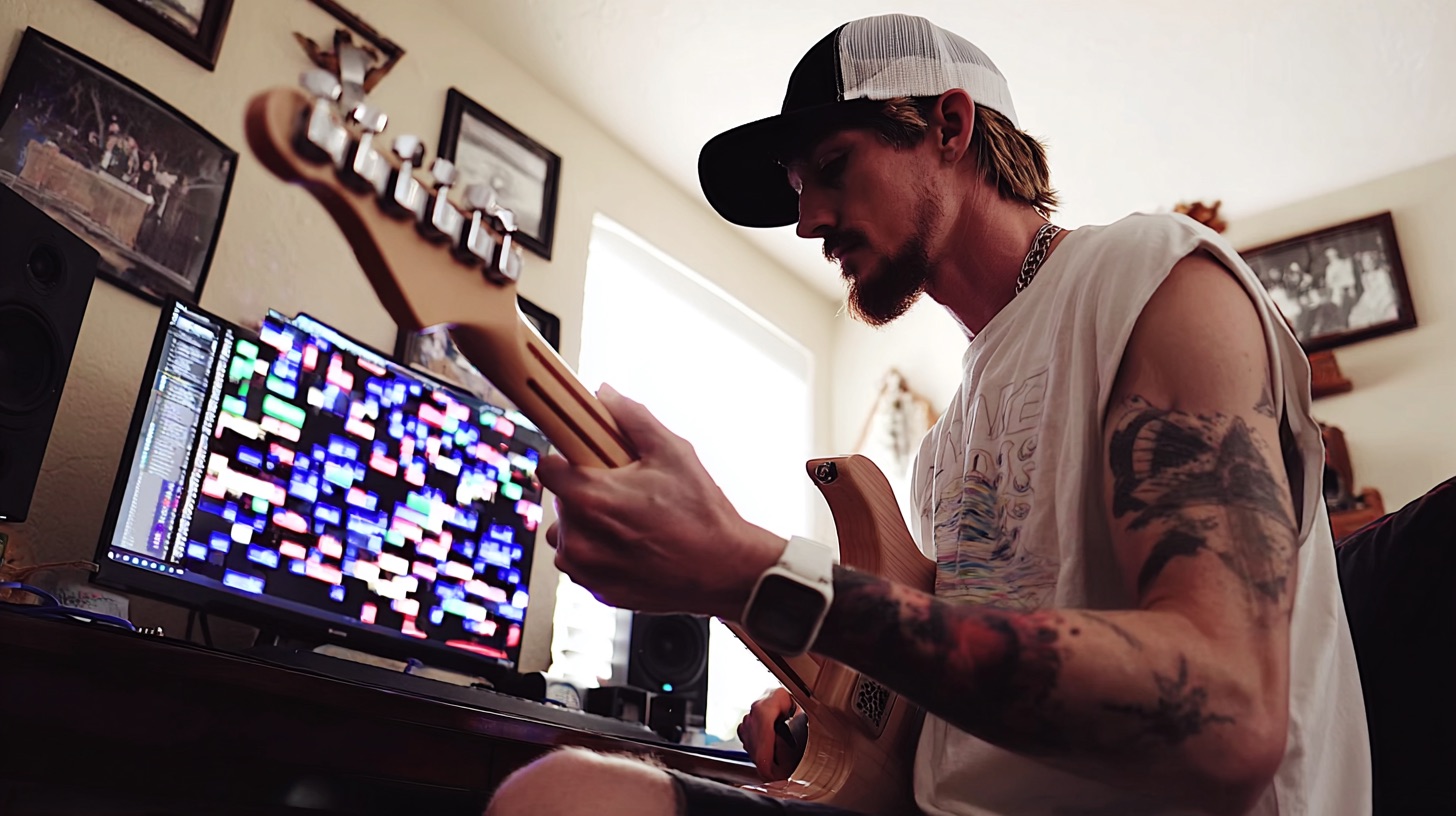
There is no substitute. Practice your parts to a click track relentlessly. Don’t just play along with the click; aim to bury it. Record yourself and visually inspect the waveforms in your DAW. Are your palm-muted chugs perfectly aligned with the grid? Or are they slightly behind or ahead? This kind of self-analysis is how modern players achieve superhuman tightness.
Step 2: Get a perfect DI capture
Your recording chain is crucial. A typical modern metal setup is:Guitar -> Noise Gate -> DI Box -> Audio Interface
The DI box splits the signal. One path goes into your interface's Instrument/Hi-Z input—this is your clean, unprocessed DI signal. The other path can go to your amp or modeler for monitoring.
Capturing a clean DI is non-negotiable because it gives you ultimate flexibility. You can re-amp later, use different amp sims, and edit the performance transparently without baked-in distortion artifacts.
Step 3: Use the right tools
- Amp Sims & IRs: The quality of amp sims like STL Tones, Neural DSP, and Amplitube is undeniable. But the real magic often lies in the Impulse Responses (IRs). Pairing your favorite amp sim with third-party IRs from companies like OwnHammer, York Audio, or Celestion can elevate your tone from good to great.
- Editing: Even the best players aren’t perfect robots. Use your DAW's editing tools (like Pro Tools' Elastic Audio or Reaper’s Stretch Markers) to nudge any slightly off-beat notes into place. Focus on locking the transients of the guitar to the kick and snare. This isn’t "cheating"; it’s production.
What are the key mixing moves for modern metal guitars?
Once you have a great recording, mixing is about carving out space and adding impact. It’s less about broad strokes and more about surgical precision.
High-pass and low-pass filtering
This is your first move.
- High-Pass Filter (HPF): Cut out the unnecessary sub-bass mud. Start around 80Hz and slowly move it up until the guitars start to sound thin, then back it off a bit. For a standard-tuned rhythm guitar, this could be anywhere from 100-150Hz.
- Low-Pass Filter (LPF): Tame the harsh, fizzy top-end that can sound like static in the mix. Start around 12kHz and bring it down. You can often go as low as 8-10kHz without losing crucial attack. This helps make room for the cymbals.
Surgical EQ for clarity
The "mid scoop" is a classic metal move, but modern production is more nuanced. Instead of a wide scoop around 400Hz, use a parametric EQ like the FabFilter Pro-Q 3 with a narrow Q to find and cut specific "honky" or "boxy" frequencies. Look for problem areas in the 300-800Hz range. This ensures you remove the mud without gutting the essential body of the tone.
For a deep dive into these techniques, check out our guide on EQing metal guitars for max impact.
Strategic compression
Compression on heavy guitars isn’t about smashing the dynamics; it’s about control.
- Standard Compression: Use a compressor with a medium attack and fast release to even out the difference between palm mutes and ringing open chords. You’re only looking for 2-3dB of gain reduction.
- Multiband Compression: This is a secret weapon. Use a multiband compressor to specifically target the low-end "chug" frequencies (around 80-200Hz). This allows you to tighten up the palm mutes without affecting the clarity and attack of the top end. Learn more about advanced compression techniques with our metal compression secrets beyond just making it loud.
Ready to see how the pros really do it?
Reading about techniques is a great start, but there’s no substitute for watching it happen in real-time. The best modern players and producers—the ones setting the new standards—have internalized all of this. They don’t just know the rules; they know when to break them.
At Nail The Mix, you get to be a fly on the wall as the world’s top producers mix real songs from bands like Gojira, Lamb of God, and Periphery from scratch. You get the raw multitracks so you can follow along and mix them yourself.
See how legendary Nail The Mix instructors like Eyal Levi, Zakk Cervini, and Jens Bogren tackle these exact problems. Watch them dial in tones, make surgical EQ cuts, and apply compression to create polished, professional-sounding mixes.
Dive into the full catalog of NTM sessions and see how the best in the business build those killer guitar tones from the ground up.