Download Decapitated “Just A Cigarette” raw multi-tracks
Nail The Mix Staff
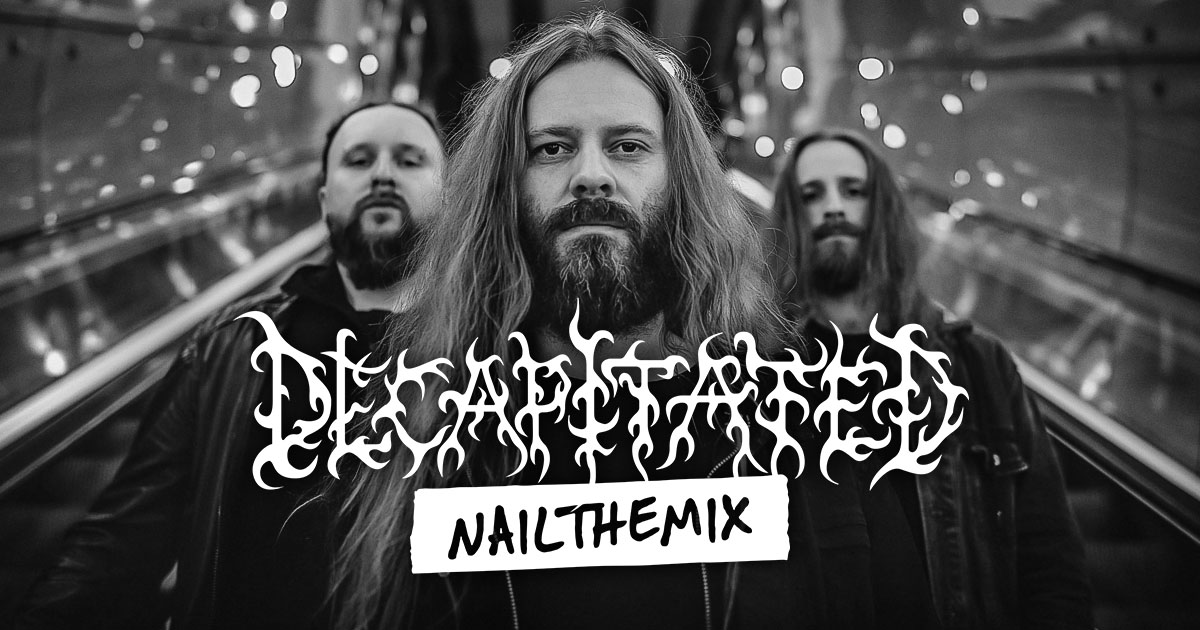
When you think of technical death metal, you think of Decapitated. Vogg is, without a doubt, one of the most respected and punishingly precise guitarists in the entire genre. So when we got the multi-tracks for their song “Just A Cigarette,” we knew we were in for a treat… and a challenge.
The session, mixed by the legendary David Castillo, clocks in at a staggering 118 tracks. This isn’t just about massive track counts for the sake of it; it’s a masterclass in modern metal production that gives the mixer an insane amount of control. Let’s break down some of the key elements of this session and the production techniques you can learn from them.
The Quad-Tracked Guitar Onslaught
Let’s start with the obvious: the guitars are monstrous. Vogg’s performance is a clinic in tight, articulate, down-picked aggression. The sheer power in his right hand is something few guitarists on earth can match. To capture this, the production team went all in.
We’re talking quad-tracked rhythm guitars. But it gets crazier. Each of those four performances was recorded with four or five microphones on the cabinet. Do the math—that’s a ton of guitar tracks to wrangle. Opening this session for the first time can be intimidating, but it’s also a goldmine of tone.
Taming the Beast with Bus Blending
So, how do you handle 16-20 tracks of rhythm guitar without creating a muddy mess? One of the most effective strategies is to create your own “master tones” using bus sends.
Instead of trying to EQ and process every single microphone track individually throughout the mix, simplify your life. For each of the four guitar performances, create a bus or group track. Route all the associated mic tracks (e.g., the SM57, Royer R-121, MD 421, etc.) to that bus.
From there, you can blend the mics to create one perfect, cohesive tone for that single performance. Maybe the SM57 provides the mid-range bite, the 421 gives you the low-mid weight, and a condenser adds some air and top-end fizz. Blend them with the faders, pan them slightly if you wish, and use some light EQ to get them working together. Once you have a blend you love, you can treat that single bus as your “guitar track.” Do this for all four performances, and your session suddenly goes from 20 guitar tracks to a much more manageable four stereo stems.
This approach not only cleans up your session but gives you a richer, more complex tone than any single mic could ever provide.
Next-Level Drum Production: Splitting the Performance
Here’s where the production on “Just A Cigarette” gets truly impressive. When you solo the overheads, you’ll hear the cymbals, snare, and toms, but the kick drums are suspiciously absent. That’s because they were recorded separately.
That’s right: the drummer performed and recorded his hands (the parts played on cymbals and shells) in a completely separate take from his feet (the double-kick patterns).
Being able to do this—essentially turning off half your body and playing a complex part perfectly in time—is an incredible display of ambidextrous skill and musicianship. Very few drummers can pull this off with this level of tightness.
The Payoff: Absolute Control in the Mix
Why go to all this trouble? It’s all about sonic purity and giving the mixer ultimate control. By separating the hands and feet, you eliminate bleed almost entirely.
- No Kick in the Overheads: You can slam your overheads with a compressor to bring out the cymbal wash and decay without the kick drum hits causing the compressor to pump unnaturally.
- No Cymbals in the Kick Mics: You can get super aggressive with your kick drum EQ and gating without hearing weird cymbal artifacts every time the gate opens and closes.
This separation allows you to apply extremely focused metal compression strategies to individual parts of the kit. You can shape the transient of the kick and the body of the snare with surgical precision, because their microphones aren’t contaminated with sound from other parts of the kit. It’s a pro-level technique that is key to achieving that clean, powerful, and punchy drum sound found in modern metal.
Bass and Vocal Mixing Challenges
The same detailed approach applies to the rest of the instruments, each presenting its own unique mixing puzzle.
Crafting a Flexible Bass Tone
The session gives you four distinct bass channels: a DI, a condenser mic, an amp head, and more. This isn’t just for redundancy; it’s for flexibility. In a dynamic song like this, which moves between brutal sections and dark, sinister clean passages, one bass tone won’t fit all.
You can blend the clean, sub-heavy DI signal with a heavily distorted amp tone to get the best of both worlds: low-end foundation with an aggressive mid-range that cuts through the dense guitars. For the cleaner sections, you can automate or mute the distorted tracks entirely, leaving a cleaner, more nuanced bass tone that serves the music perfectly.
Balancing Brutality and Clarity
The vocal performance is absolutely savage. But even the best-recorded brutal vocals come with challenges, namely managing chaotic mouth noise and harsh plosives (“P” and “B” sounds).
The key here is to find the perfect balance between raw aggression and intelligibility. A great starting point is to use a de-esser to tame the sibilance, but you may need to get more surgical. Manually editing the waveform, using clip gain to turn down loud pops, or using a dynamic EQ to duck the offending frequencies are all great ways to clean up the track. Applying the right EQ strategies for mixing modern metal will allow you to maintain that raw power while ensuring the vocals sit cleanly in the mix.
Mix It Yourself with Nail The Mix
Reading about these techniques is one thing. But what if you could actually get your hands on all 118 tracks from this Decapitated session and apply these concepts yourself?
That’s exactly what you get with Nail The Mix. When you subscribe, you can download the raw multi-tracks for “Just A Cigarette” and craft your own mix from scratch.
Decapitated on Nail The Mix
Daniel Bergstrand mixes "One-Eyed Nation"
Get the Session
Even better, you get to watch a full-length livestream where the original producer, David Castillo, builds his entire mix from the ground up, explaining every single plugin, setting, and decision along the way. It’s the ultimate way to see exactly how pro-level metal records are made.
If you’re ready to move beyond presets and see how the pros handle monumental sessions like this one, grab the Decapitated multi-tracks and join Nail The Mix today. For an even deeper dive into the fundamental concepts of production, check out our intensive course, Unlock Your Sound: Mixing Modern Metal Beyond Presets.